
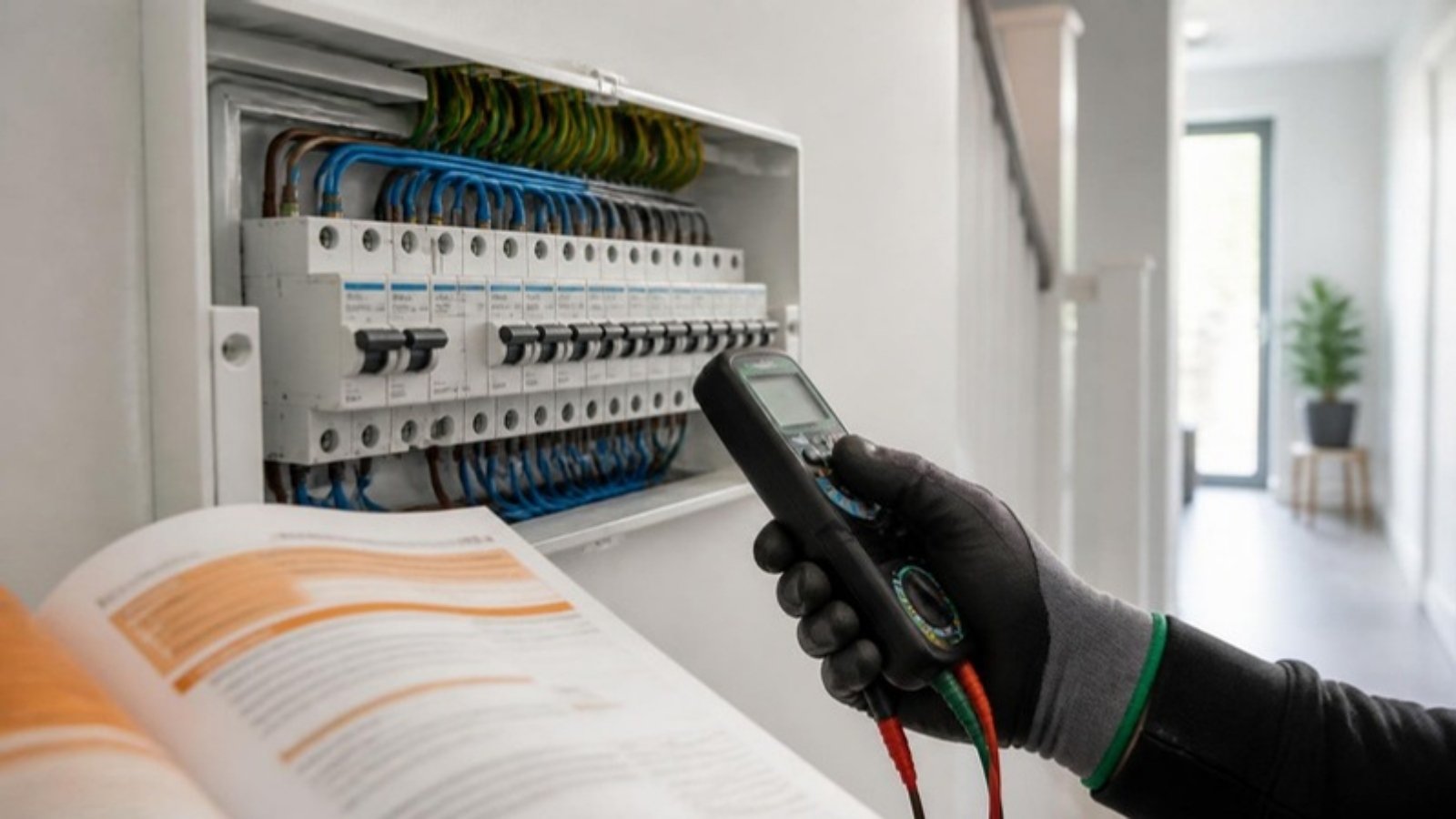
 Illustrative image
- Since 15 October 2026, all new electrical work and EICRs in the UK should be carried out to BS 7671:2018+A4:2026.
- On an EICR, FI and C3 observations no longer make a report Unsatisfactory on their own — only C1 and C2 do.
- There’s a brand-new chapter covering home battery storage.
- Your existing electrics don’t automatically become unsafe — the regulations aren’t retrospective.
On 15 October 2026, Amendment 4 to the IET Wiring Regulations — officially BS 7671:2018+A4:2026 — became the only recognised version of the UK standard for electrical installations. The previous version (Amendment 3, the “brown book”) was formally withdrawn the same day. Amendment 4 was published by the IET and BSI on 15 April 2026, giving electricians six months to get ready.
The Wiring Regulations aren’t law in themselves, but they’re the benchmark used to judge whether electrical work is safe — by building control, by Part P competent person schemes like NAPIT, and in the rules landlords have to follow. So when they change, it affects what you get on your certificates.
What it means for your EICR
The change most people will notice is on Electrical Installation Condition Reports. Under Amendment 4, observations are split differently, and an FI (further investigation) or C3 (improvement recommended) code no longer makes a report Unsatisfactory on its own. A report is Unsatisfactory where there’s a C1 (danger present) or C2 (potentially dangerous) observation.
In plain English: an inspector still has to record anything that needs looking into, but you shouldn’t see an otherwise-safe installation “fail” purely because something couldn’t be fully checked on the day. Your report will also state which version of BS 7671 it was done to — look for “2026” on reports from now on.
A new chapter for home batteries
Home battery storage — often paired with solar panels — is one of the fastest-growing jobs in UK homes. Amendment 4 adds a new Chapter 57 on stationary secondary batteries, covering how they’re selected and installed, protection against shock and heat, isolation, ventilation and fire protection. If you’re thinking about a battery, make sure whoever fits it is working to the new chapter.
Other changes in brief
- Arc fault detection devices (AFDDs): the requirement now refers to high-rise residential buildings — over 18 metres or more than six storeys.
- Power over Ethernet: a new section (716) covers PoE cabling for things like CCTV, Wi-Fi access points and smart lighting.
- Functional earthing for ICT equipment: a new section (545), including pink identification for functional earthing conductors.
- PNB earthing is included for the first time, and certificate forms have been updated to suit.
Do I need to upgrade my electrics?
No — not just because the regulations changed. BS 7671 isn’t retrospective: an installation that met the rules when it was put in isn’t automatically unsafe today. What matters is whether it’s safe, which is exactly what an EICR checks. If you’re a landlord, or you haven’t had your electrics checked in the last ten years, now is a sensible time.
Need an EICR done to the new Amendment 4 standard? From £140, report issued same day.
- NICEIC – Understanding BS 7671:2018 + Amendment 4:2026
- Virtual College – BS 7671 Amendment 4: what electricians must do before 15 October 2026
- IET E&T – UK electrical wiring standard update brings new rules
- BSI – BS 7671:2018+A4:2026
This article is general guidance, not legal advice. Always check the latest official guidance for your situation.